

Bicycle Network Victoria: Better Transport
Latest Transport News
Bus lane rights threat
2 November 2011. The prospect of bikes being legally welcome in all bus lanes has been dashed by a sudden and rapid policy swerve by the State Government.
Following a long and thorough evaluation of the bike and bus lane sharing concept by VicRoads, which gave the idea the thumbs up, it had been expected that the Government would soon give the all clear.
But the long-expected reform is now under threat and bike riders may be forced to share the bus lanes with fast-moving motorcycles.
The sudden change was sprung with the announcement this week of a 'trial' of motorcycles using one of Melbourne's bus lanes.
According to a statement by VicRoads 'the purpose of the trial is to assess the operational and road safety impacts of allowing motorcycles to use a selected bus lane so an evidence-based decision can be made on whether to permit motorcycles in bus lanes on a permanent basis.'
The trial will start in November and last for six months.
Apparently one of the expected bus lane attractions for motorcyclists is 'travel time benefits'—in other words, they will be able to travel much faster.
Mixing fast traveling motorcycles and bike riders in a car-free lane flies in the face of world's best practice in reducing risks to bike riders.
Surely there was detailed policy analysis to justify this jump into the unknown? Actually, no. The reason, according to VicRoads was that 'during the 2010 Victorian State election, the Government committed to a range of motorcycle initiatives, including the trial."
And now that the commitment has been made, the search is on for evidence to justify it.
"The trial has been carefully scoped as it needs to support evidence based decisions on the future use of bus lanes by motorcycles, particularly from a safety perspective.
"A detailed understanding of motorcycle behaviour and bus operations prior to the trial will be documented. This will be compared with the behaviour and operations that occur during the trial.
"Of particular importance will be quantifying the benefits (and dis-benefits) to motorcycles, buses and other road users."
The trial site will be the southbound bus lane in Hoddle Street. This site was selected after establishing site selection criteria and examining all metropolitan Melbourne bus lanes for their suitability, and consulting with a range of key stakeholders. Hoddle Street southbound was selected due to:
- The relatively high number of buses and motorcycles should provide sufficient information for the study.
- The multiple locations to observe motorcycle and bus interactions such as at stop lines and at bus stops.
- The length of Hoddle Street means that motorcycles should be attracted to the bus lane due to the likely travel time benefits over such a length.
- The bus lane is neither narrow nor wide, and hence motorcyclists will need to make a judgement on whether to pass between a stationary bus or not.
- The congested traffic in the adjacent lanes.
Bicycles, taxis, VHA/B/C (Victorian hired cars) are currently permitted in the Hoddle Street inbound bus lane.
Bikes step up to the plate
19 October 2011. There is a chance that bikes could benefit from the announcement by the Premier, Mr Ballieu, that Victoria's number plates will in the future carry a safety message.
Addressing the Liberal Party State Council in Bendigo, Mr Baillieu said the new safety message would be selected after extensive consultation.
"What better place to reinforce road safety messages than on number plates," Mr Baillieu said.
"We want to hear from Victorians across the state – drivers, cyclists, pedestrians, children – this is an issue that affects us all.
"It is about getting people thinking and talking about how to improve road safety.
"We know that continual reminders and reinforcing messages are an important part of road safety public education.
"The new number plates will effectively mean hundreds of thousands of reminders to drive safely on our roads every day."
Mr Baillieu invited Victorians to submit their ideas here.
Bike-specific concerns were not included in the survey, but there is a box for "other".
Riders with ideas should fill in the survey and let the Premier know that the interests of Victoria's bike riders should be taken into consideration in the development of the new plate slogan.
The new number plates are expected to roll out in Victoria next year.
Bike strategy fails to reach potential
24 August 2011. The State Government's bike strategy started off in the right direction, but has not lived up to its promise, according to the Victorian Auditor-General.
The 2009 strategy was a first, important step for Victoria to significantly raise the profile and role of cycling as part of a more sustainable transport system, the Auditor General, Mr Des Pearson said.
But serious limitations in its development and implementation compromised its potential to achieve its goal.
The report "Developing Cycling as a Safe and Appealing Mode of Transport" is said to be the first such scrutiny of the effectiveness of government bike strategies.
"The strategy was developed in haste without sufficient understanding of either current cycling journeys or what was required to ‘mainstream’ cycling as a form of transport," Mr Pearson said.
"In addition, agencies were not well prepared to implement the strategy or evaluate its success, and this contributed to the unsatisfactory progress in addressing its limitations.
The Auditor's staff met with Bicycle Network Victoria during the preparation of the audit, and made use of count data and other performance evaluation material gathered by Bicycle Network Victoria.
Mr Pearson said the strategy was not comprehensive because it did not include sufficient measures to effectively protect
and educate cyclists, to promote cycling, to invest in facilities and to make car travel less attractive. These measures had been particularly effective in European countries
He also said it based on an insufficient understanding to determine what was needed to ‘mainstream’ cycling and to establish meaningful targets against which to gauge the success of the strategy.
Major recommendations are that the Department of Transport and VicRoads should:
- complete implementation plans, when developing future cycling strategies, that describe objectives, time lines, resources and responsibilities and how a strategy will be managed, monitored and reported
- improve the quality of project plans so that they consistently meet agencies’ internal requirements by creating better practice templates
- finalise evaluation frameworks, when developing future strategies, that describe outcomes, realistic targets, benchmark data and how success will be measured and reported for component projects and for the overall strategy
- develop a sound basis for informing and implementing government policy through an improved understanding of current and potential cyclists, the journeys they make, the barriers to ‘growing’ cycling and how to best overcome these
- apply the mechanisms required to effectively coordinate actions to ‘grow’ cycling and improve information sharing across the government agencies and non-government organisations involved in cycling
- in consultation with other managers, review and update guidance on the construction, maintenance, auditing and retrofitting of shared bicycle paths and agree on the maintenance arrangements for the finalised Principal Bicycle Network.
Lazy roads a waste of space
28 July 2011. The long standing road manager doctrine that a travel lane must be a minimum 3.5m wide is unjustified, is costing the community money, and is penalising bike riders.
Roads are some of the most and valuable real estate in our cities and regions, yet we are wastefully under-utilising them.
The state and local government tradition of over-specifying the width of a typical traffic lane has created ‘lazy’ roads that are not delivering the value the community demands.
The belief that wide lanes are safer lanes is know regarded as myth.
This means that bike lanes can easily be placed on many roads—with no safety compromises—simply by adjusting travel lane width.
In practice many busy travel lanes are well under 3.5m wide. The lanes over the Westgate Bridge are now 3.1m wide. When the lanes are set at this width and the speed is limited to 80kph, there is enough room on the bridge deck to fit in another lane of traffic.
But these intelligent departures, successful as thy are, are yet to lead to fundamental changes to practice or the belief in the 3.5m ‘standard’.
Now a study from SKM draws attention to this contradiction.
The Traffic Lanes Widths on Urban Roads report summarises the current research on the performance of wider and narrower lanes and makes the important point that wider lanes do not necessarily lead to safer roads.
This report opens the door to widespread use of optimised travel lanes that will allow our roads to carry more people.
The benefits of optimised lanes accrue to all modes. In the Westgate example, by optimising the lanes other motorists benefit. In other cases optimisation has enabled the installation of priority bus lanes and other capacity increasing measures.
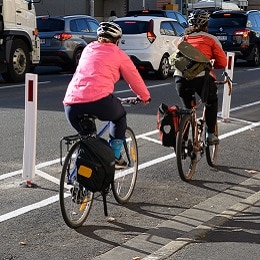
One opportunity that arises on state and local roads is the chance to delineate space for bike riders.
Bicycle Network Victoria and VicRoads figures show that the number of people travelling into the Melbourne CBD on bicycles each day has steadily increased over the past six years. The number of riders has more than doubled in this period while motor vehicle volumes have remained steady or dropped slightly.
Much of this increase in bike riding has come on roads reconfigured to allow marking of bike lanes. The extra bicycle lanes have been installed without adverse impact on motor vehicles lanes or capacity. So, overall, marking of bike lanes has allowed us to fit more people into the same road at minimal cost.
The bike lanes on three major arteries running into Melbourne’s CBD - Royal Parade, St Kilda Rd and Flemington Rd, illustrate the results. All have 1.5-1.8m wide bike lanes in the service lanes (outer lanes) of the road. These were fitted in by narrowing the widths of the motor vehicles lanes and the parking lanes to allow the marking of separate space for bicycles.
According to VicRoads figures, the bike lanes on the three roads carry over 7500 people each weekday and over 2200 people in the morning peak. Excluding trams, people on bicycles now make up five percent of the people travelling on these roads. On St Kilda Rd it is over seven percent.
Imagine an extra 2,500 cars on St Kilda Rd each day (or 6,000 over the three roads) - the bike lanes carry these people on a 1.5m lane!
Bike lanes on busy roads do not suit all potential riders but for existing roads they do let us cater for adult commuter cyclists. The more separation we can provide for riders the higher the potential usage.
The bike lanes on St Kilda Rd, Royal Pde and Flemington Rd show that many people will ride if given some space on our roads in the form of a marked bike lane.
If traffic engineers are prepared to optimise urban road lane widths then many or our roads can carry more people without major capital works.
This is a win for everybody.
It is time for our road managers, state and local, to show us their innovative side.
Bikes and public transport a carbon priority
14 July 2011. Most Australians want to see additional spending on cycling, walking and public transport after the introduction of a carbon tax.
A poll of 1500 Australians conducted by Auspoll found that 72 per cent wanted a focus on active and public transport.
It was commissioned by a coalition of transport, environment, health and Local Government groups, including the Australasian Railway Association, Australian Conservation Foundation, Australian Local Government Association, Bus Industry Confederation, Cycling Promotion Fund, Heart Foundation, and International Public Transport Association.
The poll identified that 85% of Australians want the Federal Government to spend money on better planning to make walking and cycling for transport simple and convenient options.
Dr Lyn Roberts, National CEO Heart Foundation said: “This poll tells us Australians want to be more active, use public transport that is frequent, reliable and accessible and they want the infrastructure in place to encourage walking and cycling.
"Increased investment will encourage public transport patronage in our cities and unblock two kinds of arteries - ours and traffic.
“More than half of Australian adults (54%) are not sufficiently physically active to gain health benefits. Physical inactivity kills 16000 Australians a year and costs our health budget $1.5billion annually."
Australian Conservation Foundation CEO Don Henry said: “The money raised through the carbon price should primarily be spent on solutions, not on compensating industries that are part of the problem.
“That means building a low carbon economy and supporting the growth of clean energy and public transport.”
82 per cent of respondents to the poll supported an increase in Federal Government funding for public transport and 87 per cent of respondents supported Federal Government investment in public transport to address the issue of traffic congestion in major cities.
Mayor Felicity-Ann Lewis, Deputy President of the Australian Local Government Association said: “Local Government as the provider of the most extensive urban transport infrastructure is ready to work with industry and the other levels of government to address congestion and the emerging transport issues.”
Respondents who did not use public transport for work trips identified the coverage, capacity and efficiency of public transport as the major obstacles to using it, 70 per cent of all respondents supported the Federal Government becoming more involved in the planning of public transport in cities to address congestion.
Fear restrains riding
15 June 2011. A new survey has confirmed that Australians would happily ride a bike to work if the roads were designed to be safe for bike bike riders.
Sixty-two percent of Australians are willing to ride to work but don't because they fear for their safety.
The Australia-wide online survey of 1000 randomly selected adults was conducted by the Cycling Promotion Fund (CPF) and the National Heart Foundation. The CPF is the promotional arm of the bike industry.
Similar surveys around the world have produced similar results—more than half of commuters would ride if they felt the roads were safe and bike riders were provided with attractive facilities.
According to the survey, "Riding a Bike for Transport", the main reasons people were not commuting by bike included unsafe road conditions (46 percent), speed/volume of traffic (42 percent), not feeling safe while riding (41 percent) and lack of bike lanes/trails (35 percent).
The results confirm Bicycle Network Victoria's long-standing approach that the key to getting more people riding is the provision of infrastructure that attracts people to ride.
Among other findings of the survey:
- The majority of respondents cycle due to the health and exercise benefits obtained from cycling.
- Almost 90% of those that ride a bike for transport felt their general health had improved since starting to ride for transport.
- Respondents were also likely to be influenced by the economic benefits of cycling, as well as the environmental advantages.
- A common theme for not cycling more often was due to road traffic conditions or safety. Respondents were likely to rate unsafe road condition, speed/volume of traffic, lack of bicycle lanes or safety as key reasons for not cycling often.
- Weather conditions were a factor but issues such as lack of time or motivation were not significant factors in holding back cyclists.
- Paved paths along roads physically separated from motor traffic and paved separated trails along rivers and scenic areas were conditions that would encourage people to ride more often.
- Around 60% of respondents stated they own or have access to a bike.
- Two in five respondents that owned or had access to a bike had ridden a bike in the past month.
- Of these, 60% had ridden a bike for transport purposes.
- The majority of respondents that had ridden a bike did so for either running errands/going to the shops or for leisure and recreational activities.
- More than 60% of respondents had both cycled for running errands/going to the shops and for leisure and recreational activities.
- More than 80 percent of respondents believed the federal government should be doing more to promote a safe cycle culture and more than 60 percent wanted the government to do more to encourage people to ride a bike to work and for transport in general.