Transport statistics

See how bikes measure up in value-for-money terms.

Bicycles are probably the most cost-effective transport infrastructure available. Consider the following transport statistics and see how bikes measure up in value for money terms.

Bicycles are ideally suited for urban trips: the median trip length in Melbourne is 2.9km and 10 minutes.

Unused bicycles

There are over a million unused bicycles in Melbourne.

In Melbourne there are:

  • 2.4 million registered motor vehicles (1.47 people per vehicle)
  • 1.2 million bicycles (of which 70,000 are used each day on average)
  • 478 trams
  • 152 trains

Fitting them all in

More people on bikes can fit on the road than people in cars.

Estimated number of people an hour (as opposed to vehicles per hour) who can use a 3m wide road lane/transport reserve using:

Private car

1,0001

Bicycle

8,0001

Rigid bus

5,0001-17,0002

Articulated bus

26,0001

Light Rail

7,0001-10,0002

Heavy Rail

50,0002

(From 1. Malcolm Buchanan 2003, Achieving Sustainable Land Use and Transport Systems … Time to stop deluding ourselves and face the choices, Proceedings of Getting Serious – Transport Land Use Integration, 2003 AITPM National Conference, 25-26 September 2003, Sydney. Keynote Address From Figure 3.6; and 2. Peter Newman article in the SMH, Rail will prove the only answer down the track March 30, 2005)

Bike paths and lanes cost a fraction of other infrastructure

Average cost for one kilometre of:

Freeway

$13 million

Tram track

$8 million

Off-road bike path

$150,000

On-road bike lane

$20,000 (to mark bike lanes on an existing road)

Bikes are the cheapest vehicles

A new train

$4.6-11 million

A new tram

$2-3 million

A new bus

$320,000

A new car

$15,000 – $150,000 (or more!)

A new bike

$500

For examples of train and tram costs see Department of Infrastructure - trains and trams.

Costs of running a car

The cost of running a normal car per year is $110300/wk or $5,20016,000 a year.

(NRMA, True running costs of cars revealed by NRMA Consulting, 31 May 2002)

NRMA (2002) Multimodal travel time and cost survey (unpublished), quoted in NSW RTA’s Off to work? On your bike! A guide for easy and enjoyable cycling to work.

Transport (15.5%) is second only to food (18.2%) as the largest item of household expenditure in Australia. In New Zealand transport expenditure (20.3%) is slightly less than housing.

The proportion of income spent on transport in Australia and New Zealand is high because cars are expensive. However, the cost of buying and maintaining a bike in Australia is around 1% of the cost of buying and maintaining a car.[i]

Austroads (2000) Roadfacts 2000.

Queensland Transport and Main Roads (1999). Cycle South East: Integrated Cycle Strategy for South East Queensland. Brisbane: Queensland Government.

Not much on bikes

The State Government spends the following amounts on transport infrastructure each year (2004/04 figures):

Public transport franchises                                          $457m

($112m per year for trams; $345m per year for trains)
 
Arterial road network development                                $289.2m
 
(not including Eastlink and Federally funded road projects)
 
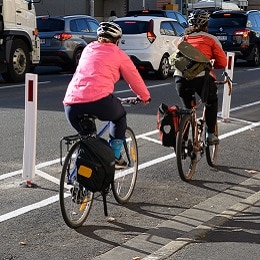
Bicycle lanes and paths                                               $5–10m
 
(including specific bike projects & those built as part of major road projects; e.g. the 14.4km path along the $306 million Craigeburn Bypass cost $3.5m)

See: DOI Public Transport Franchises


Lots of roads, not many bike paths

In Melbourne there are:

  • 30,000km of roads
  • 1,500km of bike lanes and paths
  • 380km of electrified train line
  • 500km of tram lines
  • 270 bus routes

Cars take up lots of room

Up to 16% of Melbourne’s CBD is devoted to car use, much of it for short term storage (car parks). But a single car park can fit up to 14 bicycles (usually 612) which can be used throughout the day for short trips.

Data from:


Support the people who support your bike riding. Join Bicycle Victoria.